update
After receiving feedback last week regarding my idea for the bigger workshop I had in mind, I decided to conclude that the original idea was too risky to test. However, I did test it on a smaller scale.
The easiest way to summarize my proposal involves the use of a mirror as a reflective object (both figuratively and literally), and having my participants engage in something similar to a “staring competition” with themselves. I wanted this process to help them engage with their own emotions, and write down any negative feelings that came to mind onto the mirror itself. Overall, I wanted to showcase the separation from thoughts and our identity (both physically and figuratively).
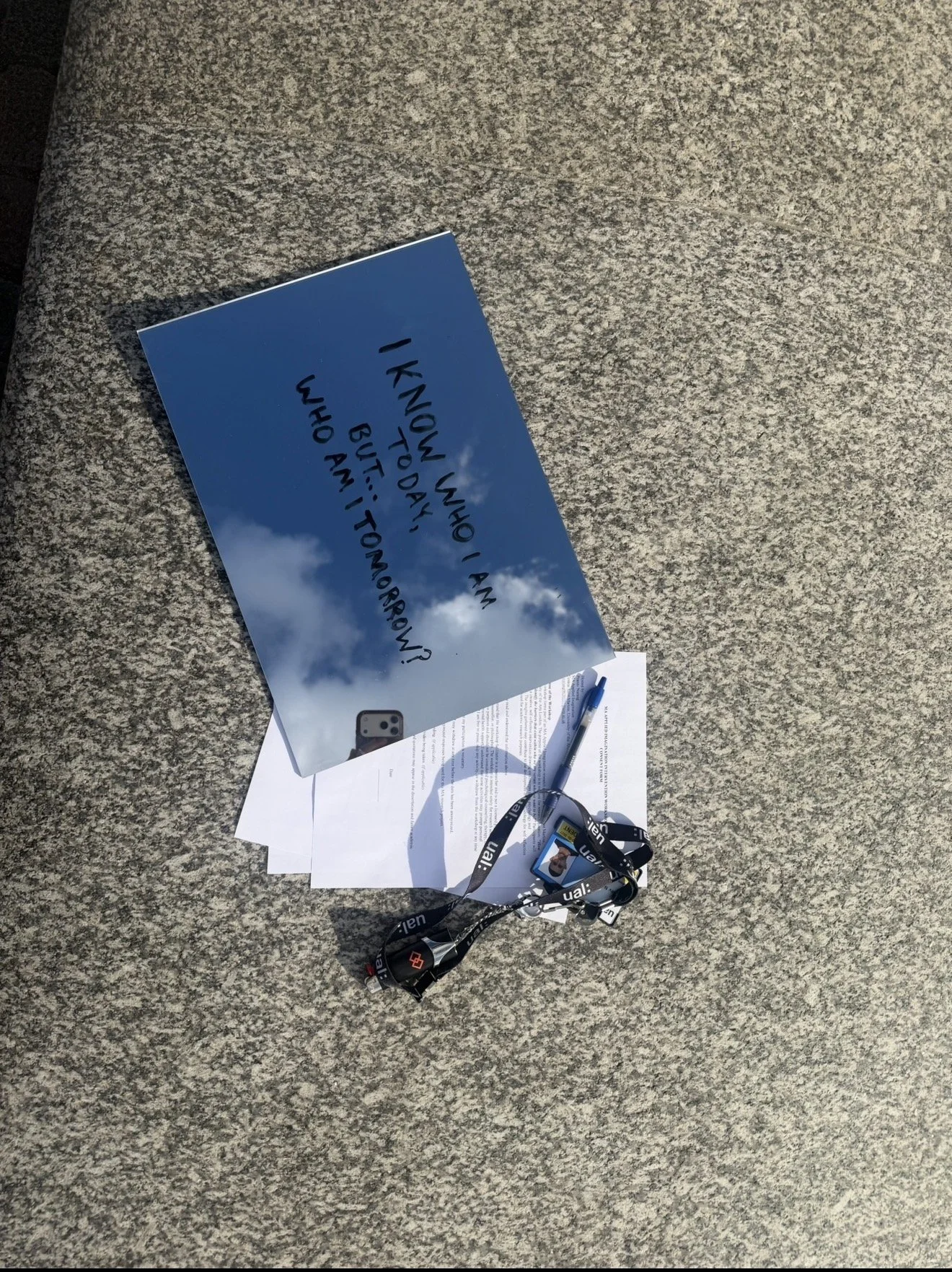
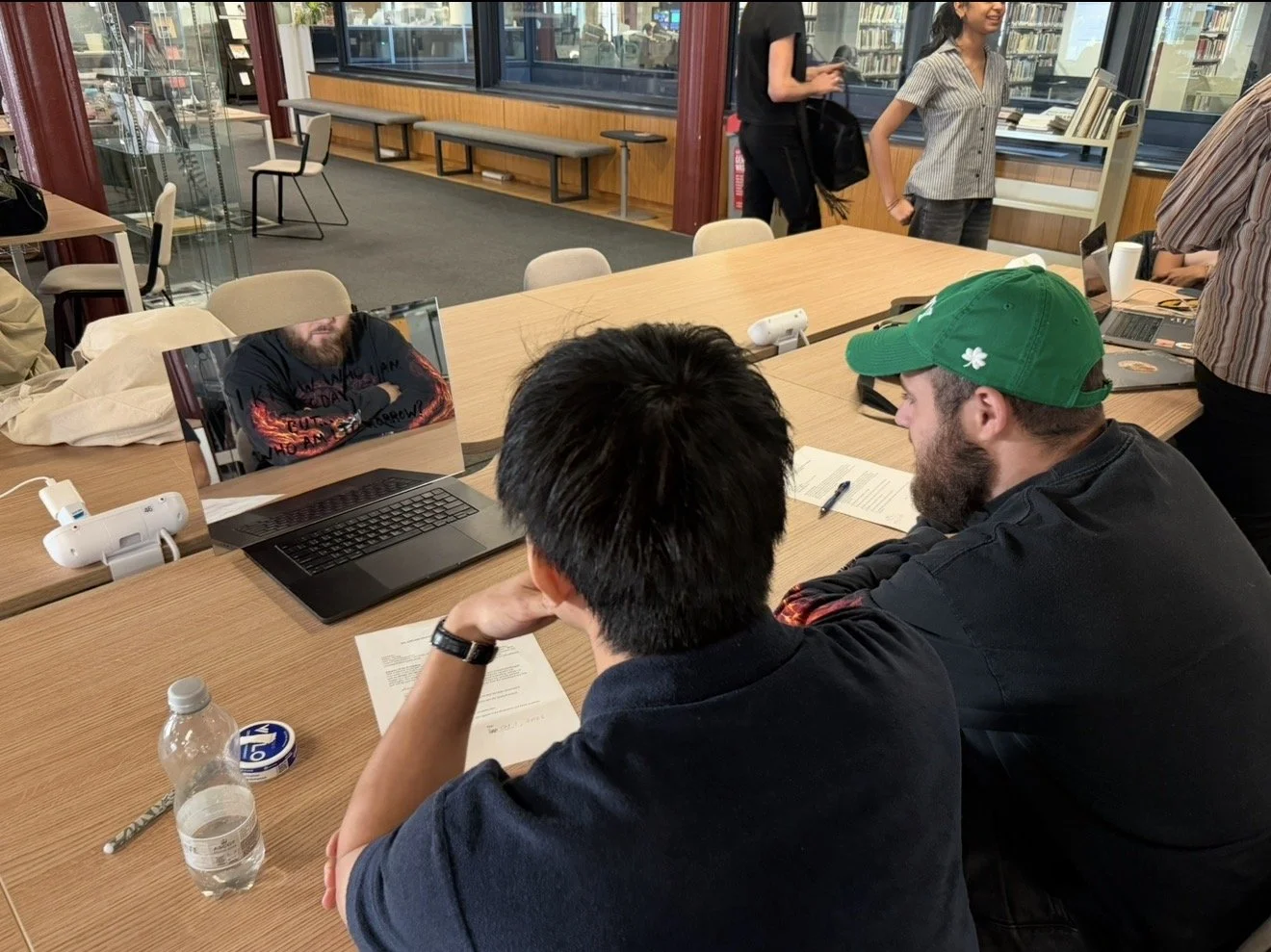
Instead, I took my original intervention “I know who I am today, but who am I tomorrow?'“ and I decided to write the question on a mirror. The idea was that placing the statement on a mirror would build instant reflection as they looked at the question and their physical reflection. I wanted them to engage with it for around one-two minutes, and share their overall experience after the minute had passed.
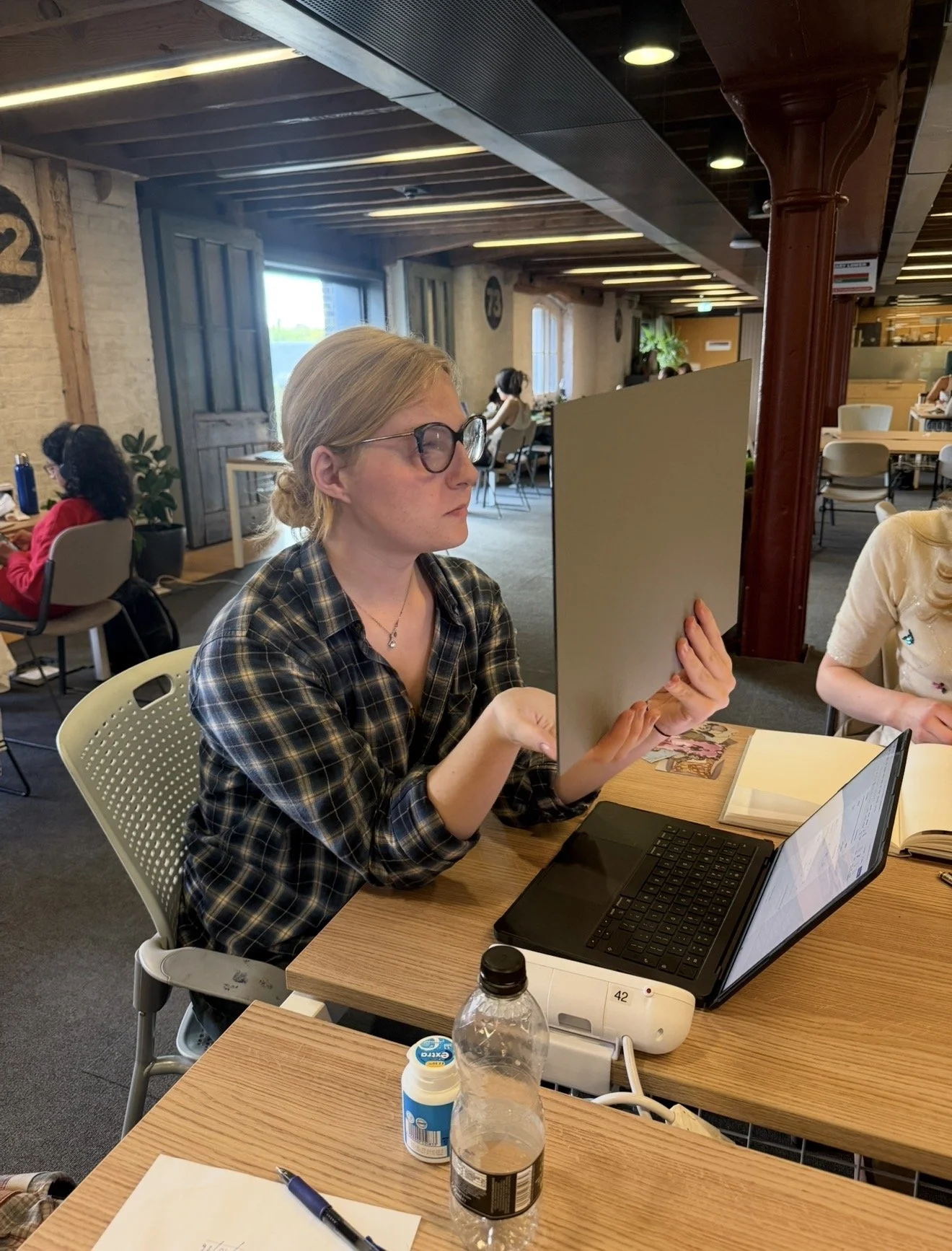
One thing I noticed with all four of my participants was that their focus on the mirror faded much faster than I expected. The longest participant held for 45 seconds when I suggested giving the activity two minutes. I also observed that some felt a bit awkward, which is understandable given the kind of activity it is in a public setting. It does make me question how much time people spend looking into mirrors at home though.
The feedback was interesting. One participant suggested that for her the statement will always be in regards to the present moment, reminding me of my conversation with hypnotherapist Sara Maude that “in true consciousness, you already are complete.” Although I suggest engaging with the activity for a minute, her interest faded in thirty seconds.
The second participant engaged for around thirty seconds in a one minute suggestion. They reflected on their current life, socially inside the walls of Central Saint Martins, and their hometown. They mentioned being the first to attend college in their family, and I could sense a feeling of pride in their tone.
The third and fourth participants engagement with the activity provided critical feedback. Although I suggested the engagement to be around two minutes, it seemed they both lost focus or interest within forty five seconds. It was interesting because it seemed as a lot came out of the activity for the two of them within 45 seconds.
One participant stated their observation regarding the structure of the question. They mentioned that “when you say I know who I am, i know what I am identifying with. And when I question who I am tomorrow - I guess its about what identity do I describe in the future. I can identify to something else with whatever framework I adapt. I think its more a mechanism itself, not something that has property in terms of identifying.” Continuing with his feedback, he mentioned Freud and how “our sense of ego is based on on what we think all at once, and usually starts off from your parents and what your parents expect from you. Later on, you start adapting from others, for example your peers in high school. All your sense of self is kind of predicated on fulfilling others desires almost. Your sense of self is created by your environment and how you internalize the environment”
The last participant provided critical feedback. He mentioned “the question itself has an assumption in a way. It assumes you know who you are, I kinda thought of variables in a way. If you know who you are today, then you know who you will be tomorrow. but also for the sake of this answer, the environment you created with the question and everything shapes the way that we think…maybe the answer would be different if it were me alone, or if it was someone else asking the question, or if I was in a private setting or in public, or maybe even different words…Everything communicates something that leads you to think something. With you guys I can be a different version when I am in a different environment but that doesn’t mean I am dishonest or fake, its just the “I” is not fixed in some scenarios.”
One final observation…the first two participants who people randomly selected provided much less feedback than the last two, who were my friends. It seems that already having established trust in the relationship allowed my last two participants to engage more proactively.
The feedback provided from this intervention was great. It helped me understand the how the concept of my intervention connects with my stakeholders. Although I did not get exactly what I was hoping for, it still helped me conclude that this intervention may not be the best fit for my stakeholders, and that I need to pivot directions to curate a more engaging activity.
Below, are pictures from the intervention itself.
"