my second workshop
Last week, I hosted my second workshop as part of my ongoing research and intervention for question, “How can we identify the barriers that exist within who we are versus who we want to be?”
As my first workshop featured 3 activities which you can see in my previous blog post, I remodeled my second workshop to focus a bit more on my participants being able to explore their vulnerability and creativity, while using this workshop to collect data for the upcoming workshops I will be hosting as part of my final outcome.
It is important to mention that the participants of my second workshop were close friends. I was concerned about how pre-conceived bias may affect the results of the workshop along with the feedback provided afterwards, however the results of the workshop surprised me.
Below, I have attached images of the four activities featured in my second workshop.
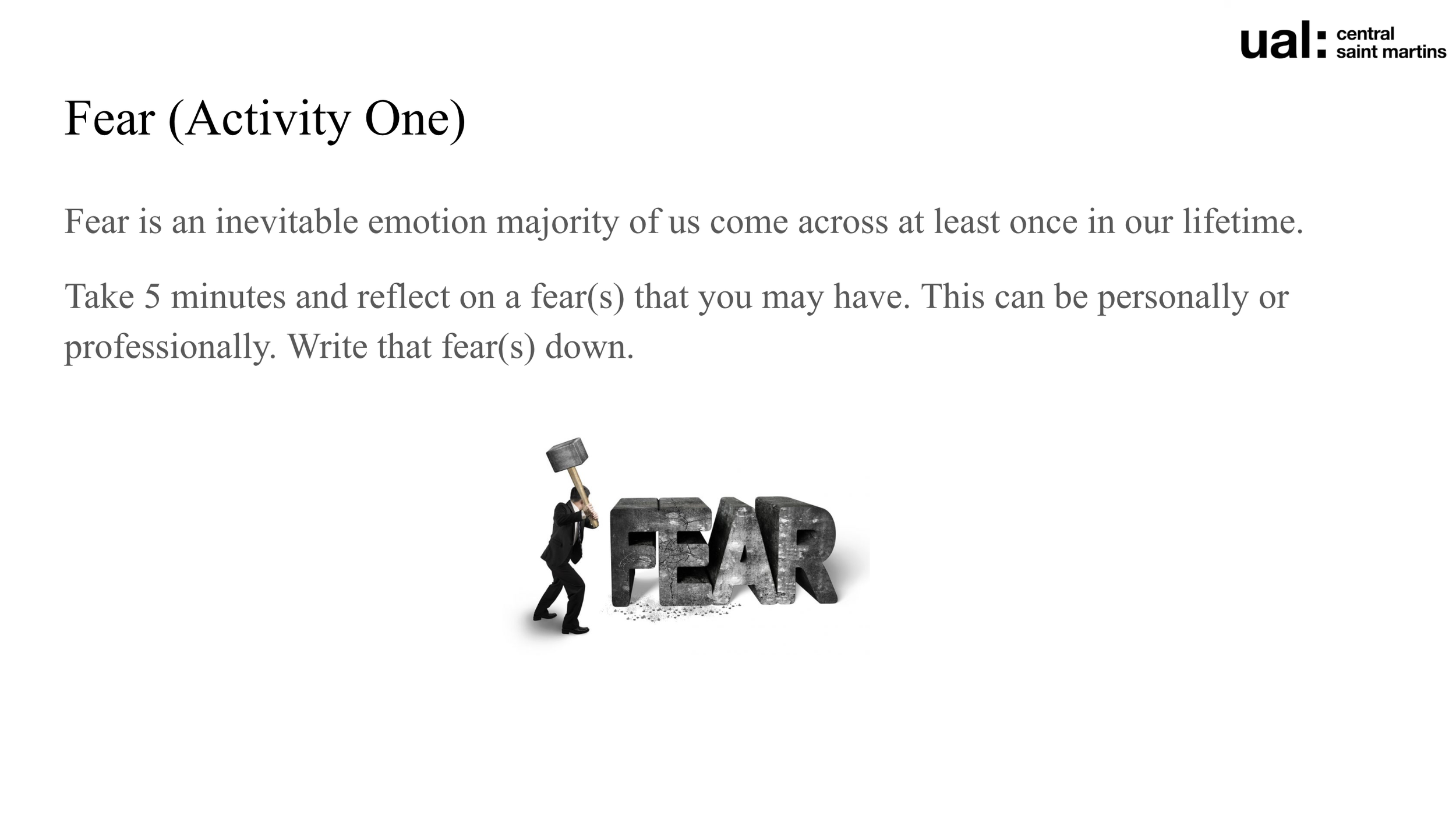
The first activity enabled my participants to explore their vulnerability. As one of the main foundations of my research started with the concern of society not acknowledging suppressed emotions, I was curious to observe how my participants reacted to writing down a list of their fear(s). The response was interesting as all four of my participating members discussed it was a struggle for them to begin the activity. However, the four of them explained that after writing down their first fear, the rest of their individual lists began to flow more easily. The list of fears themselves were not discussed as this was a personal objective for them to complete
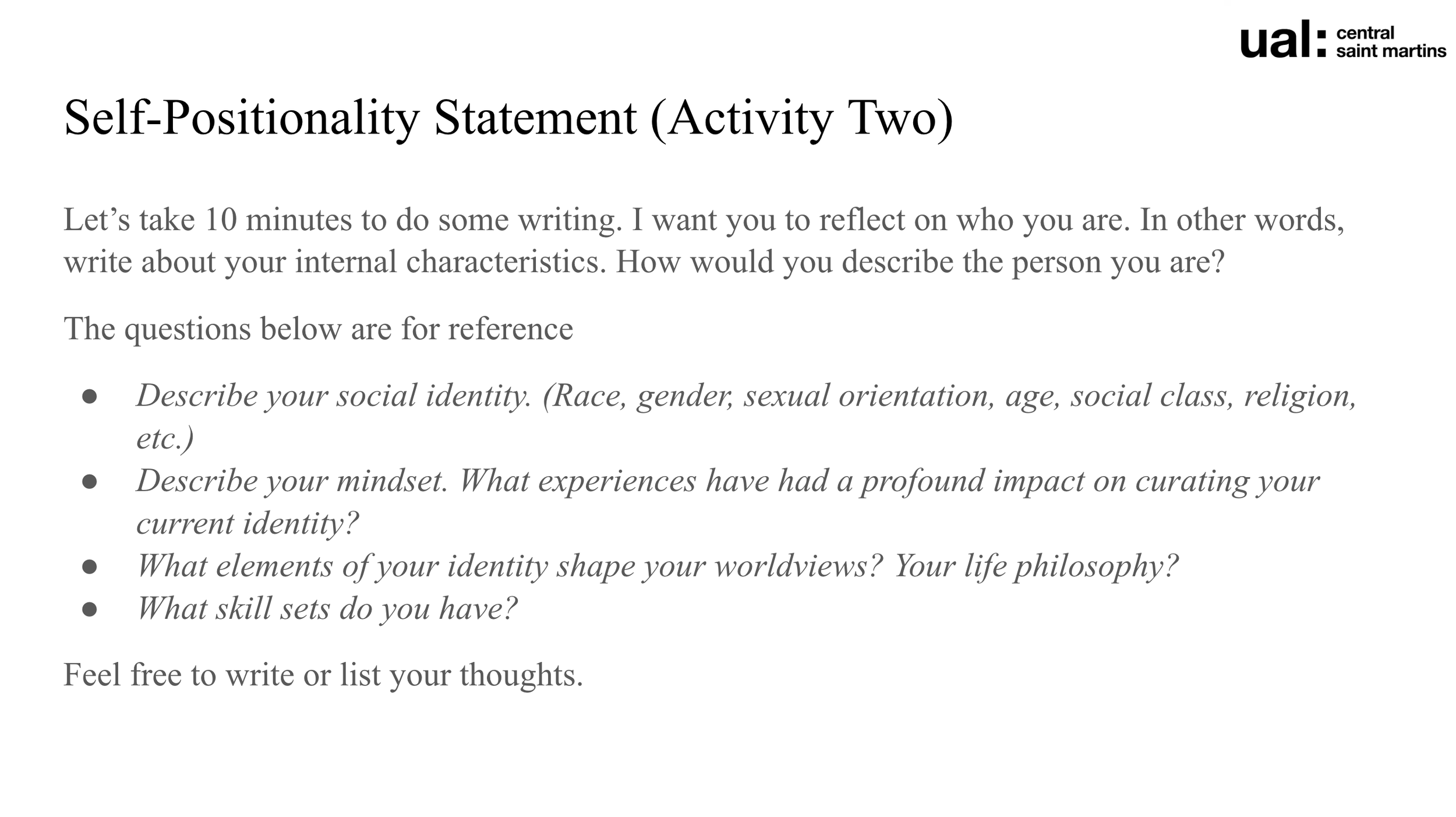
The second activity featured writing a self-positionality statement. Although self-positionality statements are meant for researchers to make sense of their social positions, a TedTalk led by Hsin-Tse (Steven) Lin suggested “taking this reflective practice and using it in our everyday lives” (TEDx Talks, 2022). Another source from the Centre of Teaching and Learning at Queen’s University listed relative questions that helped oneself identify their social position. Both resources inspired this activity in the workshop itself which later on ended up being a critical aspect of the intervention.
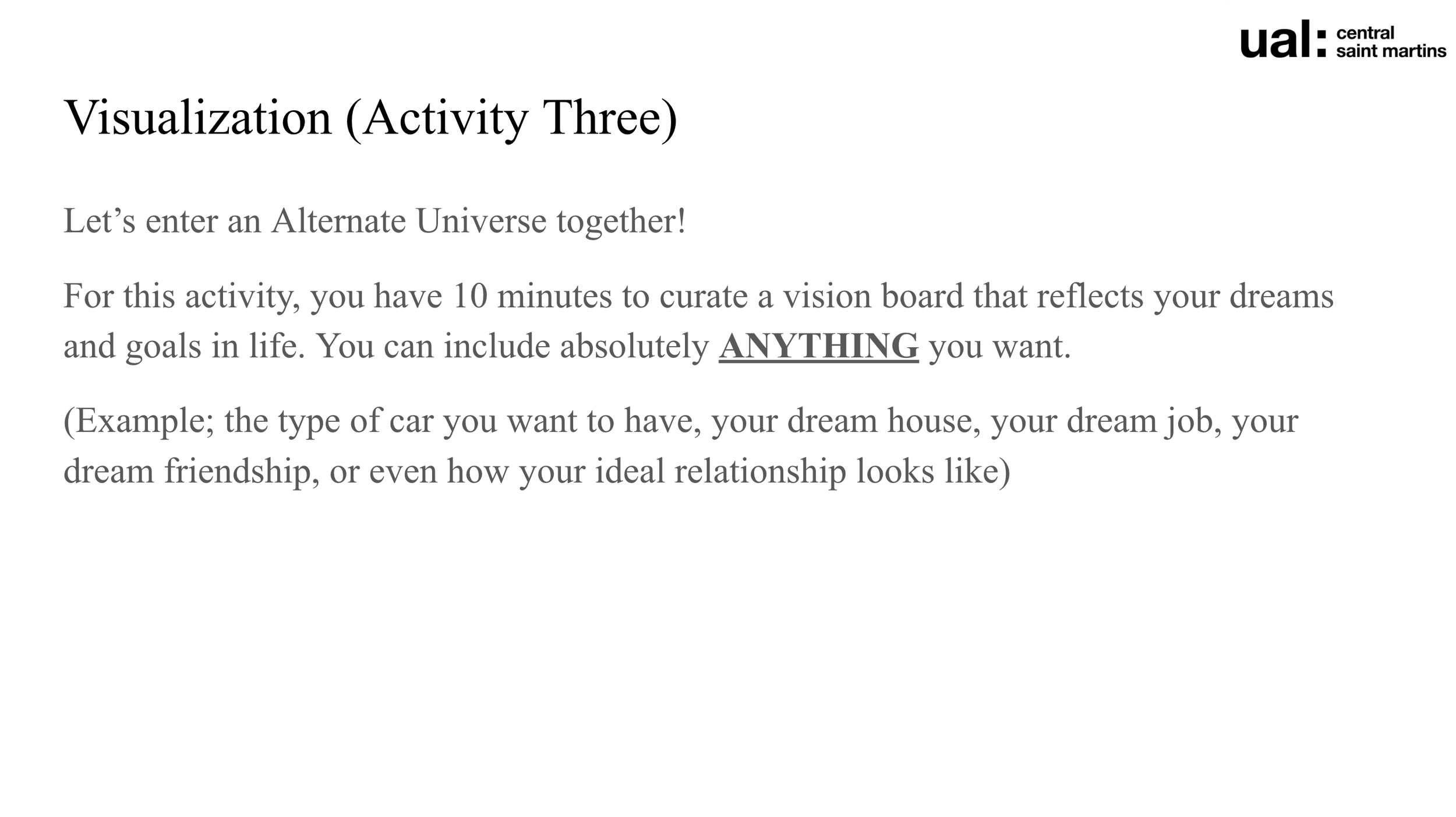
The third activity was designed to allow the participants to tap into their creative side. As one of the activities in my first workshop featured describing your future self in an alternative universe, I thought it would be more beneficial to go one step further, and allow each participant to curate a vision board based off their dreams and goals. Each participant used resources across Pinterest, Tik Tok, Instagram, and other forms of social media to gather visual resources for their vision board.
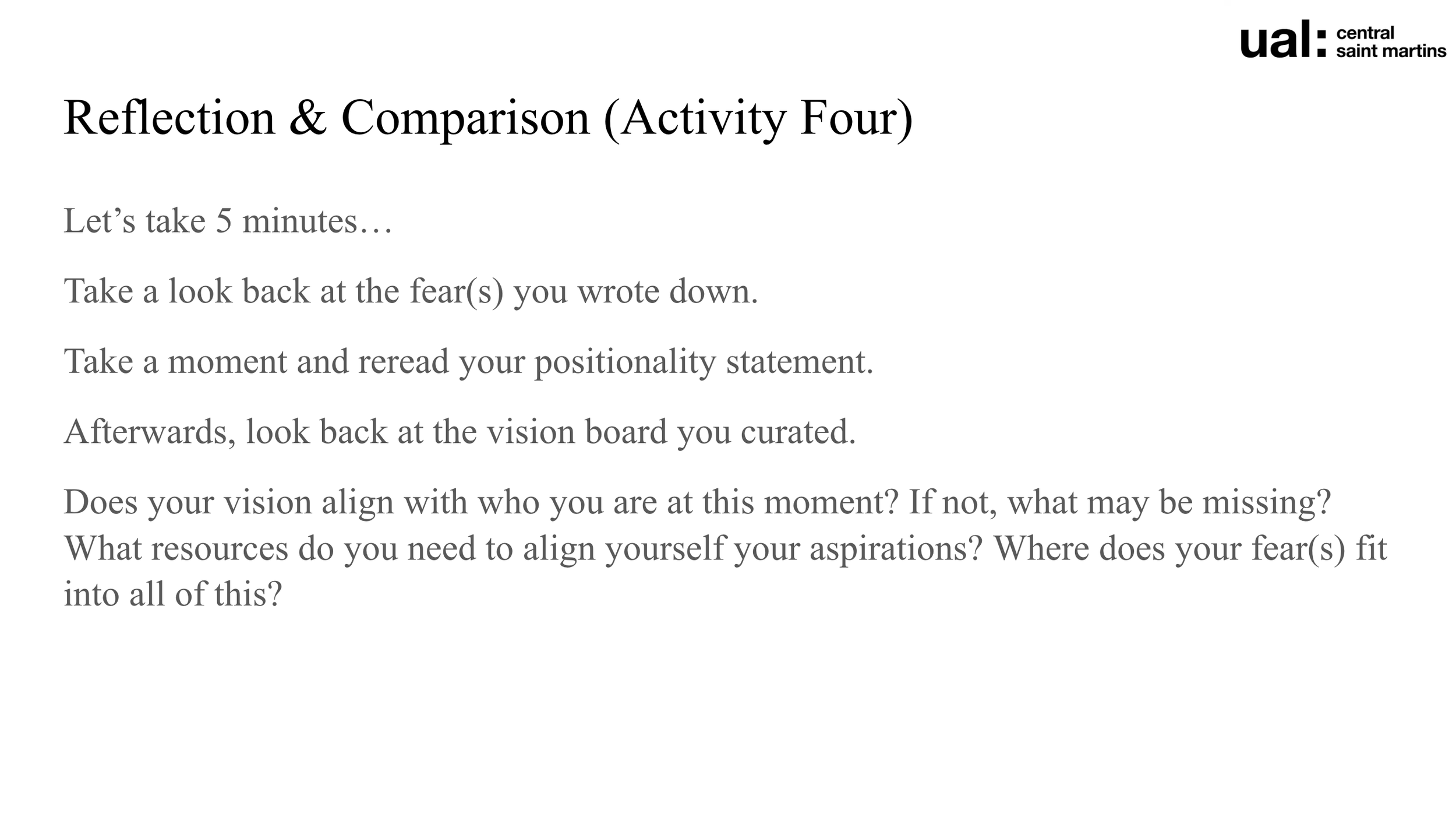
The final activity was a reflection and comparison. I asked my participants to reflect on the list of fears and self-positionality statement and compare it to the vision board each one curated. I asked a series of questions to further enhance the reflection process. The questions included “Does your vision align with who you are at this moment? If not, what may be missing? What resources do you need to align yourself your aspirations? Where does your fear(s) fit into all of this?”
The results of the overall intervention varied between each participant. I asked them to anonymously include feedback in a form I provided. I have attached the results below, for reference. The order of the feedback does is mixed up.
Question One
“What did you take away from the workshop today?”
Participant One
“Your visions are the same as your life would be now but with the absence of your fears.”
Participant Two
“I learned that we don't talk to ourselves enough. The same way it is so benefitial to talk to someone else say like a friend or therapist to get another perspective on things, Its so important to talk to yourself to even understand where these ideas, thoughts or worries are coming from. A lot of answers already live within us, we just actively choose to ignore them. At the end of the day we are scared of our own potential.”
Participant Three
“My fears originate from past experiences and trauma, but that is just what they are - the past. I can decide with every new day how to think, act and speak rather than fall victim to predispositions.”
Participant Four
“i took away that i really should sit down and write out my thoughts more often. at first i was kinda stuck and didn’t know how to express what i was thinking but once i started the ideas came pouring out. it was therapeutic, thinking about the future and the uncertainty is pretty scary but it was also a lot of fun to be able to visualize my hopes and dreams with photos (vision board) as well as words.”
Question Two
“Please list any positive or negative feedback that you may have. (This will help with the application & design for further interventions)”
Participant One
“There was a lot of time for the first few activities and more of that could have been used for vision board and/or reflection. Interesting to think about this topic though but your fears don't just disappear because you are aware of them so how do you get from point A to point B would be an interesting follow up.”
Participant Two
“I loved that we went from writing to visualizing. I find it very hard to visualize many things about my future. In fact, the uncertainty surrounding my future is a fear of mine. However, I realized that, as I mentioned previously, I know what I want at the end of the day; the answer is there. sure i still have some uncertainty but its not completely blank. I at least know how i want to feel. So why not go after that? why not chase it? Its been a long time since i sat with myself and really dug deep so I really appreciated this exercise.”
Participant Three
“- enlightening experience that forces one to reflect on their own psyche instead of acting & thinking from it. - my only critique would be to shorten and sharpen the self-positionality prompts. I didn’t know exactly what to write so referenced provided questions. In my opinion the race, age, religion and orientation questions may be unnecessary and off-topic.”
Participant Four
“the whole thing felt well thought out and intentional. this isn’t necessarily positive or negative but the entire concept felt very abstract and open ended. i struggled a bit with what to talk/write about, i just personally enjoy more instruction so i dont feel like im going off in the wrong direction. however, i also enjoyed this aspect because it challenged me and felt like there were no wrong answers. i loved how personal it all felt. i’m very intrigued to see how this translates into a whole project!”
Overall, my second workshop was a success in being able to challenge my participants to be able to explore their vulnerability and creativity.
An observation that I took away was that the participants shared that they realized their vision board projects their fears, which was an interesting take away considering their vision boards were a reflection of their goals and dreams.
I also introduced a methodology that I been have been building over the course of our independent study term, and one participant specifically acknowledged the correlation of the activities to the methodology itself, which I found personally relieving.
The feedback that stood out to me the most was, “the workshop got me 20% to identifying my barriers, but the other 80% to actually achieve the overcoming of those barriers was missing”
I found that feedback to be extremely helpful on my upcoming workshops and interventions. I want to ensure that my future participants understand that these workshops are not designed to help you overcome your barriers in a matter of one or two hours, but to understand the importance of acknowledging our feelings in relation to the goals and dreams we have. Thoughts are just thoughts, and the attached fixation of critical incidents over the course of our life tends to dilute self-perception.
Although I was hesitant to test my workshop with close friends, the feedback I received was remarkable and helps me understand how to navigate my research while avoiding exploitations that may exist. I do consider this a successful intervention with the feedback I was able to receive, both negative and positive.
My takeaway allowed me to understand possible areas of my research that I can restructure for the further development of my project.
Resources
Queen’s University Centre for Teaching and Learning (n.d.) ‘Positionality Statement’. Available at: Queen’s University
TEDx Talks (2022) ‘If We Were Mirrors: Positionality And Our Lives | Hsin-Tse (Steven) Lin | TEDxLeidenUniversity’, YouTube, 25 May. Available at: YouTube video