survey results
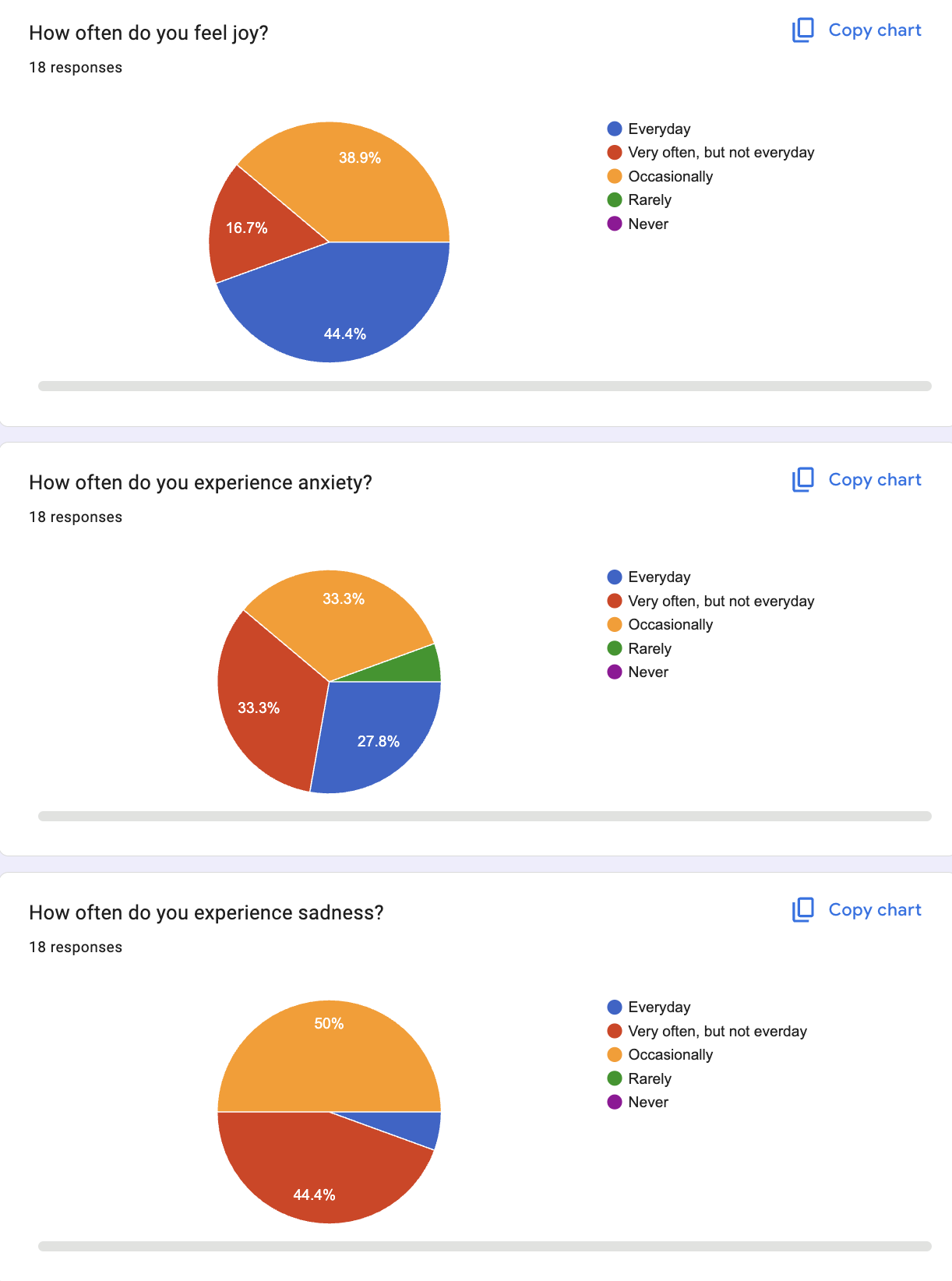
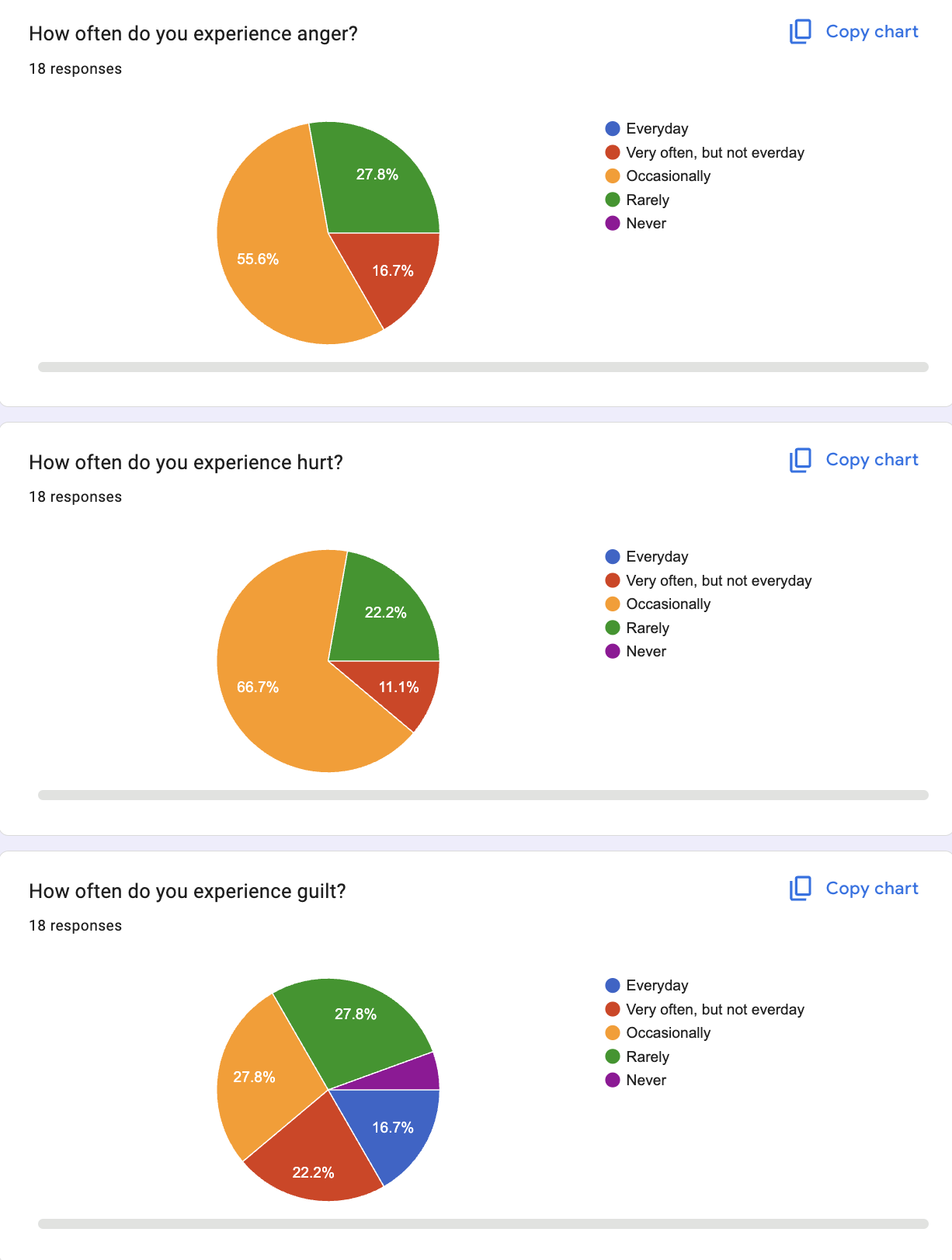
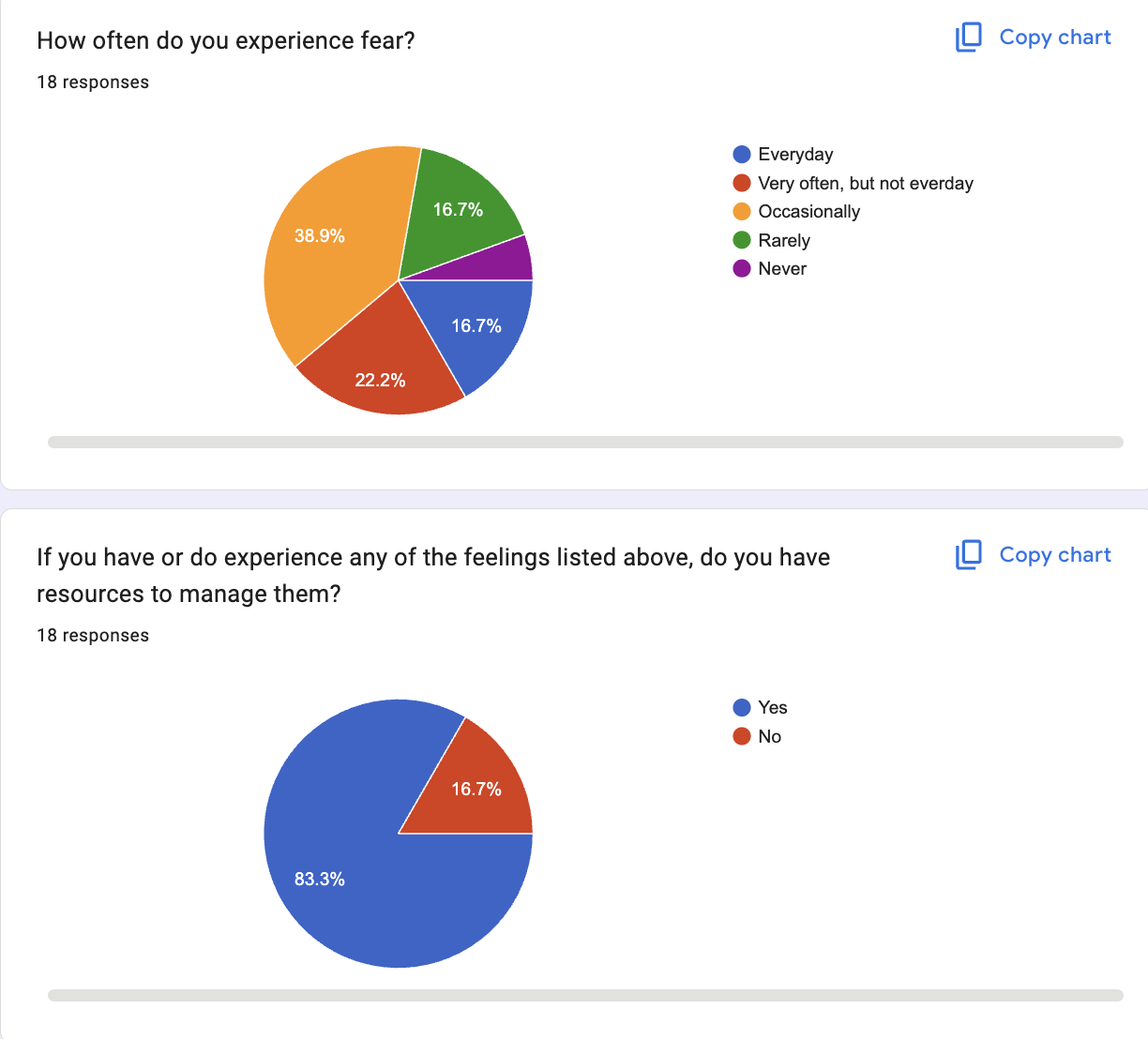
I recently put out a survey that reflects on the kinds of emotions that we feel everyday. I have been in the process of working on my final outcome , so this survey was critical into exploring how often people come across negative feelings in our daily lives. While there are endless kinds of emotions that we can feel, I did research into which negative emotions are most commonly experienced. I pulled information from academic journals and even from the movie Inside Out and Inside out Two. The emotions I chose to focus on for this survey were; Joy, Anxiety, Sadness, Anger, Hurt, Guilt, and Fear.
While the survey is still ongoing, I was fortunate to receive 18 responses. The result that surprised me the most was the ONE person who selected, they never feel fear or guilt. While I cannot measure if it was the same person who entered these responses, it makes me curious to understand what resources they may be applying to help alleviate periods of fear or guilt.
Another response that took me by surprise was regarding sadness. One person expressed feeling sadness everyday, eight expressed very often but not everyday, and nine expressed occasionally. Immediately it makes me wonder, how does sadness affect your everyday life? Does it impose limitations on you? If so, how do you let it out?
And what does occasionally mean? It was a response that was used significantly throughout the survey. So does it mean every other day? A few times a week? Once a week? Once a month? Or during specific thoughts or situations?
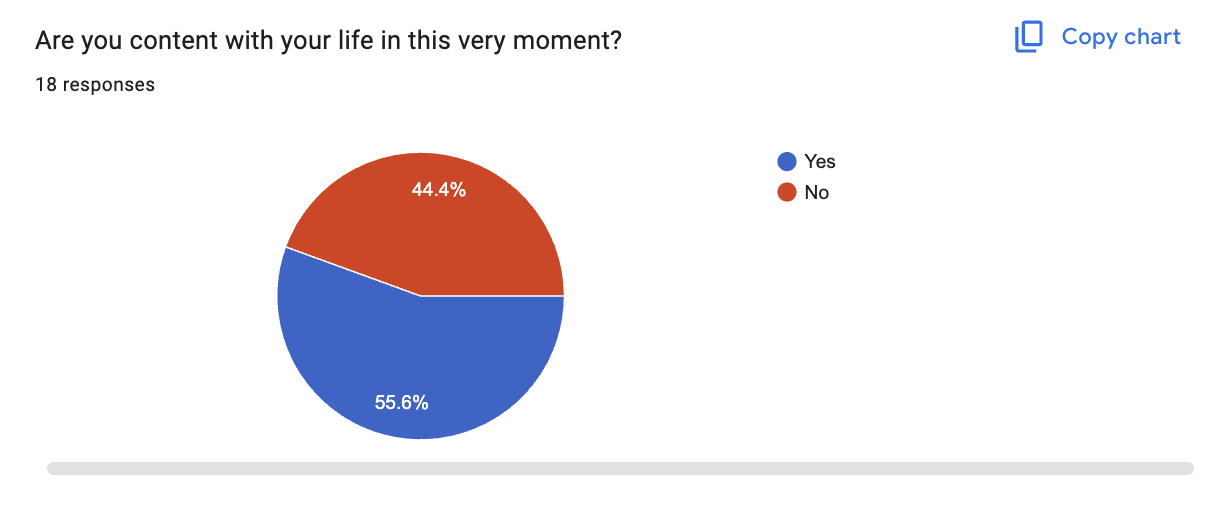
I also asked the question, “Are you content with life at this very moment?” Ten people said yes, and eight people said no. What really stood out to me the most is that out of all 18 participants, no one said that they never experience anxiety, anger, sadness, or hurt. I appreciate the honesty.
I also asked what are the resources people use to manage the feelings they come across. Below, I have listed the anonymous responses received.
Overall, this survey was extremely insightful into understanding the kinds of emotions that impact us on a daily basis. The responses from each participant into how they manage their feelings was interesting. The results vary, some people turn to music, medicine, journaling, art, working out, spirituality, therapy. etc. In a way, it is beauitful how many resources exist to help us express what is going on internally.
Participant One
“My anxiety can be quite bad. But it’s best to look at the bigger picture. I think mine tends to be impacted by the views of others and not looking so selfishly and being kinder to myself helps.”
Participant Two
“Manage Anxiety through Prescription Meds”
Participant Three
“Distraction is key for me. I try not to give in to negative emotions, especially if I feel that they have no real reason behind them. In order to do this, I reason with my mind through journaling and tend to distract myself through painting, jewelry making and sewing.”
Participant Four
“Journaling and art”
Participant Five
N/A
Participant Six
“I just know that those feelings will not last forever, like it comes and goes. And to be honest I do talk to a lot of friends about my problem. But most of the time I talk to myself about it. And I just learn to accept that I am going through something. And I feel like in the moment is hard for you to control it and you kind of just have to go through it. But just know that it will be fine eventually.”
Participant Seven
“I work as an artist so I do the job I wanted. I have a strong spiritual practice and a commitment to deepen my understanding of what it is 2b human”
Participant Eight
“Note-taking or journalling, meditation, prayer, listening to or reading from experts in the topics.”
Participant Nine
“Breathing techniques, especially 4-7-8.”
Participant Ten
“Patience and gratitude for what I am blessed with. Counting my blessings”
Participant Eleven
“I take a walk, workout, travel, and hangout with friends”
Participant Twelve
“Medication”
Participant Thirteen
“Music”
Participant Fourteen
“Spiritual Uplifting”
Participant Fifteen
“Therapy (speaking and spending time with others), crafting and reading, app games. Breathing exercises”
Participant Sixteen
“working out, making sure i take care of myself in all ways physically emotionally and mentally. Speaking kindly to myself, meditation, journaling and also allowing myself the space to feel all of these emotions I try not to shove them down”
Participant Seventeen
“First i feel like i have to recognize the feelings then have someone to talk to share about my emotions. It always helps to have meaningful conversations with people you know to help you feel better”
Participant Eighteen
“I try to laugh a lot because laughter is the best medicine. Aside from that, what I wear everyday definitely has an impact on my mood. If I feel good in my outfit I feel good internally.”
Resources
Breakthrough Leadership (n.d.) ‘The 5 major negative emotions’. Breakthrough Leadership. Available at: https://breakthroughleadership.co.uk/coaching/the-5-major-negative-emotions/
Docter, P., del Carmen, R., Rivera, J., LeFauve, M. and Cooley, J. (2015) Inside Out [Film]. Burbank, CA: Walt Disney Pictures/Pixar.
Mann, K. (2024) Inside Out 2 [Film]. Burbank, CA: Walt Disney Pictures/Pixar.
Verywell Mind (n.d.) ‘An overview of the types of emotions’. Verywell Mind. Available at: https://www.verywellmind.com/an-overview-of-the-types-of-emotions-4163976
Webb, J. (2023) ‘35 commonly felt emotions and what they mean’, Psychology Today. Available at: https://www.psychologytoday.com/gb/blog/childhood-emotional-neglect/202303/35-commonly-felt-emotions-and-what-they-mean